GREEN IN THE GRID by Swathi Vandkar
This project explores the transformation of a large, abandoned industrial land parcel located in the heart of a dense metropolitan city. Once an active textile mill, the site had been left vacant for years, creating a physical and social void within an otherwise vibrant urban core.
Rather than treating the site as an isolated redevelopment opportunity, the proposal positions it as a city-making intervention, one that reconnects fragmented urban fabric, relieves surrounding pressure points, and introduces new public life into the city center.
ECOPOLIS: Intervention for an Abandoned Mill Land
Project Type
Urban mixed-use development | City- center regeneration
Date
August 2020
Location
Bangalore, India


Let me tell you where this place comes from before I tell you what I did to it.

Setup of hydroelectric power station in 1902
Establishment of Cantonment
Establishment of Indian Woolen, Cotton and Silk Mills
City Expansion and Development
Downfall of Mills due to Plague
Mill Abandoned for more than a decade
Defunct Land
The dilapidated Mill buildings were completely demolished in the year 2025

1897

1995
1935


2005
Before it was a project, this was a pause in the city.
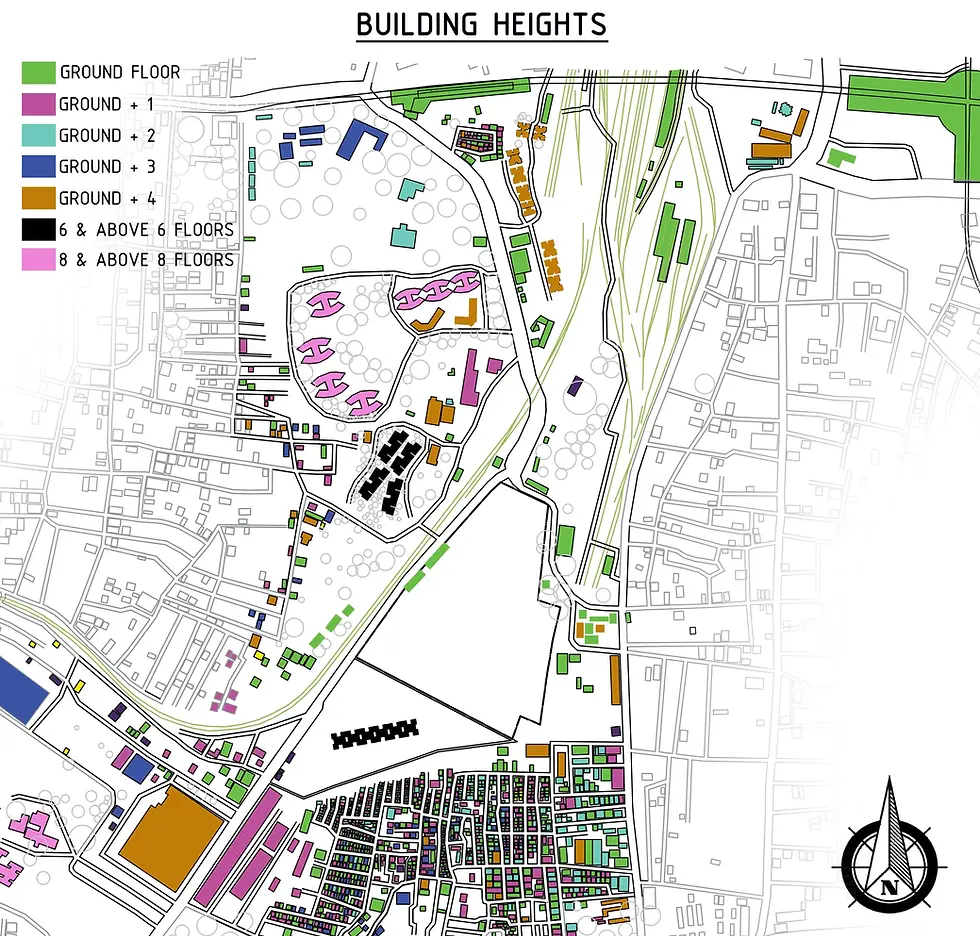
The site is a large abandoned industrial parcel in the heart of the city. Once active and closely tied to the city’s economy, it was dismantled after industrial activity stopped and left vacant within an otherwise dense urban fabric.
Over time, this emptiness began to influence its surroundings. Traffic increased along the edges, informal activities moved into the streets, and the lack of public space intensified congestion instead of relieving it. What remained was not just unused land, but a missed connection within the city.
This project begins by asking how such dormant land can return to urban life, not as an isolated development, but as an open and breathable part of everyday movement.
THE URBAN PRESSURES & CHALLENGES
The city didn’t wait for the site to catch up.
While the land remained dormant, the city around it accelerated.
Located along a narrow but critical city artery connecting major transit hubs, the site became part of a growing bottleneck. Traffic congestion intensified, pedestrian movement fragmented, and everyday urban activities began competing for the same limited street space. The challenge was not isolation, but overload.
ENVIRONMENTAL GAPS - Where the city forgot to breathe.
Years of neglect transformed the site’s edges into hard, inhospitable zones.
Vegetation was minimal, streets lacked shade, and informal waste dumping replaced ecological systems. What should have functioned as a buffer between movement and habitat became a stripped-down corridor, offering neither environmental relief nor pedestrian comfort.
SOCIAL FRICTION - Public life existed, just without a place to land.
The area remained socially active, but spatially unresolved.
Without designated public spaces, everyday city life spilled onto the streets, vendors setting up informally, gatherings occupying carriageways, and movement slowing into chaos. The absence of structure didn’t reduce activity; it intensified conflict between people, vehicles, and space.


DESIGN INFERENCES AND PROGRAMME
Design didn’t begin with form. It began with pressure.
.webp)
Not a guess. A response.
The design program responds directly to the site’s pressures. Rather than adding a new object, it absorbs and reorganizes traffic, informal activity, and public life into a coherent urban system.
Making space for movement
Severe congestion along the site edge highlighted the need for a larger public realm. By breaking the old compound wall, the design widens the street edge, eases bottlenecks, and allows the site to support city movement rather than add to the strain.
Formalizing what already exists
Street vendors and informal markets were seen as systems to support, not remove. A dedicated vendor zone brings these activities off the road, reducing congestion while improving hygiene and preserving livelihoods.
Giving public life a place
Religious gatherings, processions, and everyday social activity lacked a safe, defined space. The program introduces a cultural plaza and flexible public zones, allowing these events to unfold within the site instead of spilling into traffic corridors.
A program that belongs here
Surrounded by housing but located near major transit hubs, the site called for a different urban role. Hospitality, offices, retail, and culture come together as a mixed-use center- active through the day, responsive to the city’s transient and local populations alike.
SHAPING THE FORM
Designed to let air move, light filter, and the city cool itself.

The form began with an organic reference of three spreading leaves, chosen for their openness and overlap rather than symbolism alone. This geometry was simplified into three distinct building masses, allowing different programs to coexist without forming a single heavy block.
The key move was the split. By breaking and shifting the massing, the design creates open voids that let light, air, and movement pass through the site. These spaces respond to the local climate by encouraging cross ventilation, reducing heat build up, and helping the dense urban core breathe.
Instead of resisting the city’s intensity, the form works with it, breaking down scale and turning density into a porous, climate responsive structure.

Conceptual sketch of the elevation


.webp)

The SPLIT Concept
PLANNING THE EXPERIENCE
From city-scale logic to human-scale movement.


The Master Plan: Weaving the City Back Together
The master plan is conceived as a porous extension of the city rather than a gated enclave. Boundary walls are opened up to widen narrow roads and ease traffic, while pedestrian movement is prioritized to pull people from the busy street into a central cultural plaza.
A dedicated vendor zone lines the site edge, creating a formal marketplace that clears the streets without displacing local livelihoods. Nearly half the ground plane is kept open for landscape and circulation, helping reduce heat build up and bringing breathing space back into the city.
Floor Plans: Zoning & Flow
At the podium levels, the plan is designed as an active public layer. Retail and food spaces are organized around a central atrium that anchors movement and orientation. Large, open spans allow flexibility for the mall and food court, while multiple entry points separate public access from residential circulation.
As the building rises, the plan breaks into three distinct blocks. This shift creates quieter, more private zones for offices and service apartments, clearly separating work and stay functions from the public base.
Between these blocks, breathable voids are introduced. These gaps guide north winds through the building, improving natural ventilation while visually breaking down the scale of the high-rise.


A Machine for Ventilation
The section reveals the project’s core sustainable strategy. The "Split Level" manipulation is visible here - floor plates are staggered to allow visual connectivity across levels while strictly segregating functions.
Ventilation Strategy: The central void acts as a chimney, drawing hot air up and out while pulling cool air from the shaded green pockets at the podium level.
The Green Spine: Terraces and overhangs are integrated at every third level, bringing the landscape up from the ground to the sky.
DETAILING THE ARCHITECTURE
Performance without shouting
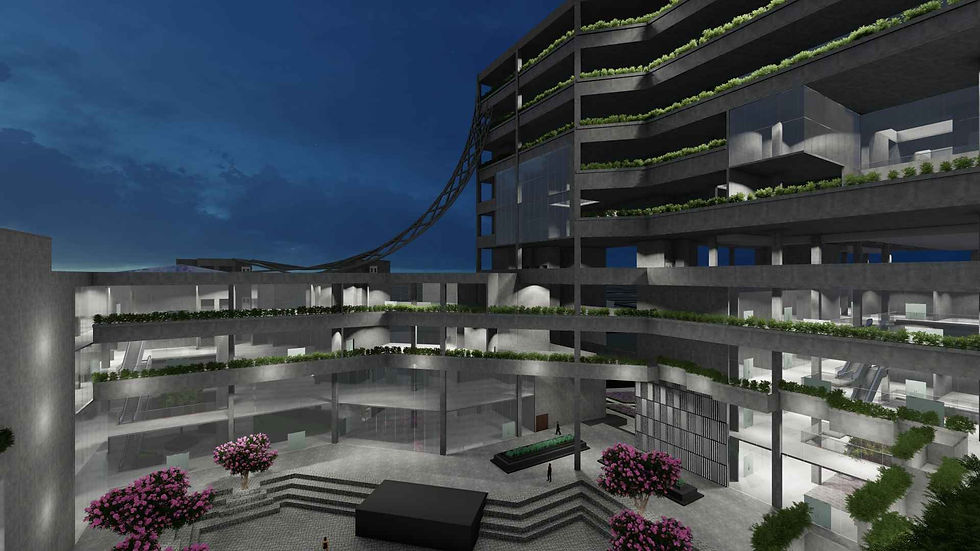
Vertical gardens wrap the podium edges and upper levels, softening the built form while reducing heat gain and creating small microclimates within the project. These planted layers are functional, shading circulation spaces, improving thermal comfort, and bringing moments of green into everyday movement. Gardens are also pulled inside the building as shaded courtyards and pockets that enhance airflow, visual relief, and daily interaction with nature.
The building is detailed to work with the local climate rather than resist it. A porous podium lifts the mass slightly off the ground, allowing air to flow through the lower levels and draw cooler breezes into the core of the site. On the south-west façade, solar panels are integrated as both shading devices and energy generators, reducing heat gain while supporting the building’s energy needs.


